
In contemporary European border work, colleagues on the other side become invaluable
In today's Nordic region, borders are both passageways and filters, where work at national crossings has become a tool for patching up ‘the cracks in the external Schengen borders’.
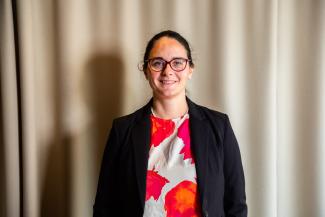
The practical work at the borders and how it is affected by new technology is the focus of the interdisciplinary research project Unpacking the Conventions Between Openness and Security in the Nordic Region: Digital Public Surveillance Practices at Three State Borders. It is led by Elena Raviola, Torsten and Wanja Söderberg Professor of Design Management at the University of Gothenburg.
“National borders have always been political objects that define countries’ jurisdictions. They have been moved through war, annexation or colonisation and politicised with slogans such as ‘strong borders’. But what does this actually mean in an integrated Nordic region?” says Raviola.
The Schengen Agreement's promise of free movement of people, goods and services has meant that border work constantly balances openness against security. The research team has reviewed a large number of documents and reports related to borders in Europe and the Nordic region, brought to the fore by various crises over the past 20 years.
There are many practical issues. In Sweden, the physical borders extend over large areas. Administrative work increases, for example, when railways cross borders, involving different owners and authorities.
Schengen increased border work
Against this backdrop, the long history of Nordic cooperation becomes particularly interesting. Raviola mentions the Nordic Passport Union from the 1950s and the Nordic Council of Ministers' goal of making the region the most integrated in the world by 2030. In parallel with this, the EU is strengthening its external border controls, including requirements for biometric identification of non-Schengen citizens, which is leading to growing European databases.
“The internal borders have become tools for catching what the Schengen border has missed – ‘the cracks in Schengen's external border’, as one informant put it. Border work is being ramped up again after a period of dismantling. This is where new technology comes in, with the hope of being able to monitor borders without closing them,” says Raviola.
Human cooperation at the border was a surprise
Surveillance is difficult to organise in practice. Closing all borders increases the burden on those who have to decide locally who is allowed to pass. The countries' systems differ and information sharing is often bureaucratic and slow.
This makes personal contacts and networks valuable. This is shown by the research group's interviews with officials at the border between Denmark and Sweden and along the 1,630 km long Swedish-Norwegian border – Europe's longest land border. In addition to customs and police, the researchers interviewed airport staff, border committees and other stakeholders.
Elena Raviola says that the discovery of how important human cooperation between states was came as a surprise.
“When border colleagues from different countries work closely together, work routines are created that help them filter and share information more quickly.”
There are several cross-border initiatives. On the Swedish-Norwegian border, the countries share the police station for the municipalities of Eda and Eidskog. Between Sweden and Denmark, a police group rotates between the countries.
Technology records everything – but interprets poorly
Technology also requires interpretation. Number plates can become illegible due to weather conditions or be linked to incorrect data.
A new Swedish law has expanded the powers of the police in certain border areas, including permission for ANPR cameras. For example, they record all vehicle passages and automatically link the data to other databases. This not only extends the boundaries geographically, but also in time, as the information is stored and can be used much later.
The researchers also aimed to explore the politically and ethically charged dimensions of borders through public engagement. In spring 2025, the project partnered with the Röhsska Museum in Gothenburg on an initiative focused on biometric surveillance. The program featured artworks, seminars, and role-playing activities with students. For example, participants were asked to narrate the story of an object encountered at a border crossing
“Rather than pointing fingers, we wanted to use speculative methods to concretise the issues. Crossing the boundaries between art and research opens up new spaces for discussion about the development of society.”
On 23 October, the innovative initiative will continue with the seminar Borders, Bodies and Databases at the IT University of Copenhagen.
For further information, please contact:
Professor Elena Raviola
University of Gothenburg
elena.raviola@gu.se